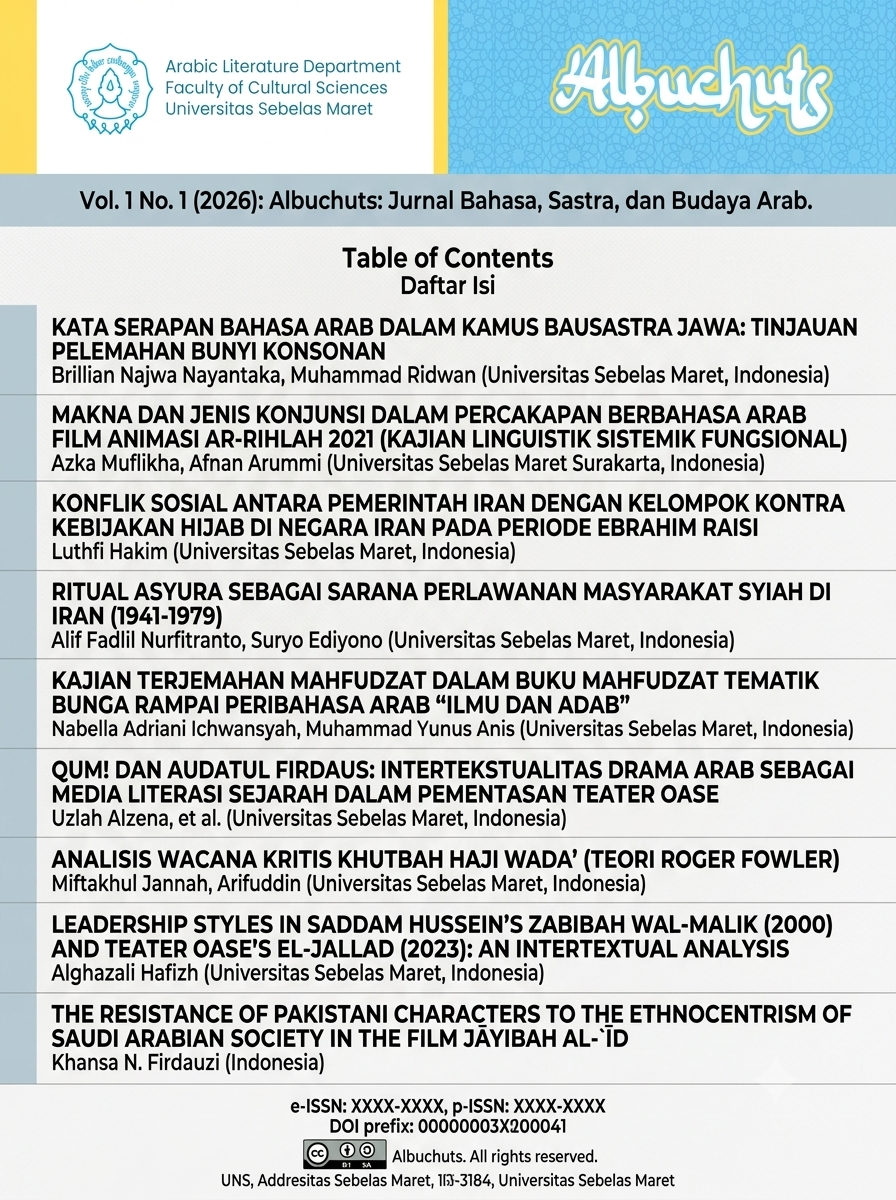
The Critical Discourse of Haji Wada' Sermon (Roger Fowler's Theory)
DOI:
https://doi.org/10.20961/0shgvz42Keywords:
Roger Fowler's Critical Discourse Analysis, Haji Wada' Sermon, Vocabulary Representation, Grammar RepresentationAbstract
Miftakhul Jannah. B0515025. 2019. The Critical Discourse of Haji Wada' Sermon (Roger Fowler's Theory). “Bachelor Thesis: Arabic Literature Department, Faculty of Cultural Sciences, Sebelas Maret University of Surakarta”.
This research discuss about critical discourse on Roger Fowler's theory: through the representation of vocabulary and grammatical aspects of Haji Wada' sermon. The purpose of this research is to reveal the discourse contained in Haji Wada' sermon through a critical discourse analysis approach to Roger Fowler's theory. This research uses qualitative research methods which are presented descriptively, namely describing critical discourse analysis on the representation of vocabulary and grammatical aspects associated with the principles contained in Haji Wada' sermons.
Based on the analysis of the text of the Haji Wada' sermon, the research results obtained are as follows: (1) on the vocabulary aspect, the Haji Wada' sermon contains discourse expressed through Roger Fowler's four vocabulary theories, namely making classifications, limiting views, fighting discourse, and marginalization. These four theories are juxtaposed with the four main principles contained in the Farewell Hajj sermon according to the book A'th-Thariq min hunnā by Muhammad al-Ghazali namely; humanism and equality, brotherhood in maintaining tranquility (social conditions) for all human beings, human rights: safeguarding the rights of other people's lives, equality between women and men. (2) In the grammatical aspect, it is found that there are patterns of passive sentence forms and noun sentence patterns (nominalization) in revealing the discourse in Haji Wada' sermons.