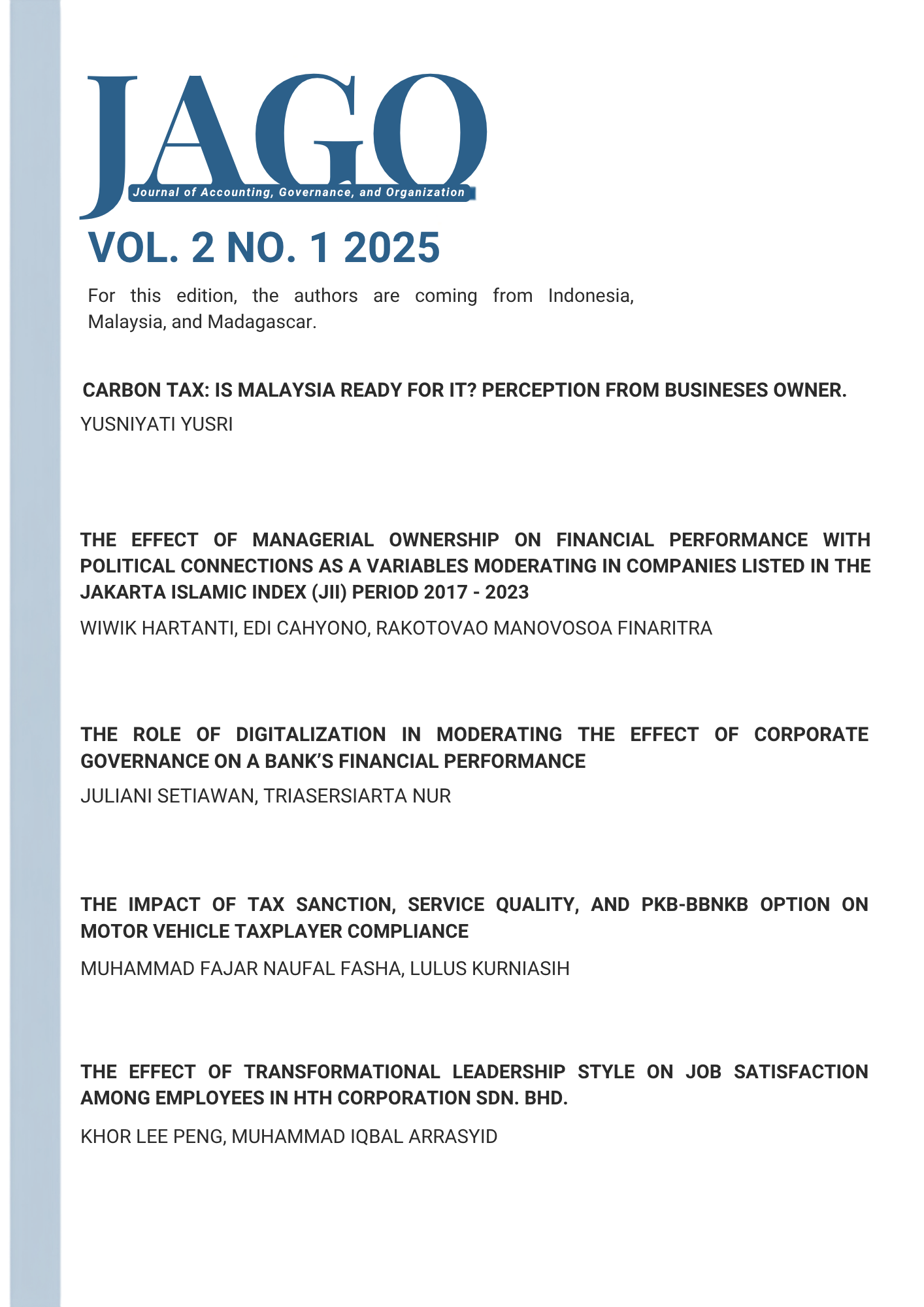
MANAGERIAL OWNERSHIP AND FINANCIAL PERFORMANCE: THE MODERATING ROLE OF POLITICAL CONNECTIONS IN JAKARTA ISLAMIC INDEX COMPANIES
DOI:
https://doi.org/10.20961/wbkebp32Keywords:
Managerial Ownership, Political ConnectionsAbstract
The Jakarta Islamic Index (JII) serves as a Sharia-compliant stock index established by the Indonesian capital market in 2000, originally consisting of 30 Sharia stocks reviewed annually. Evaluations now occur semiannually in May and November. This research investigates the impact of managerial ownership and political connections, as well as the role of political ties in moderating the financial success of JII-listed firms between 2017 and 2023. The study focused on a population of 12 companies chosen through purposive sampling. Data processing involved the use of multiple linear regression and Moderated Regression Analysis (MRA). Findings indicate that managerial ownership and political ties both positively influence financial results, and political connections effectively moderate the link between managerial ownership and financial performance.
References
Abdullah, M. H., Nurcahyono, Wibowo, R. E., & Alwiyah. (2024). The role of political connections as a moderator of the relationship between corporate governance and earnings management in transportation companies in 2019–2023. Proceedings of the Unimus National Seminar.
Agasva, B. A., & Budiantoro, H. (2020). The influence of good corporate governance and company size on company performance (A study of manufacturing companies listed on the Indonesian Stock Exchange in 2014–2017). Journal of Economics and Business Asianomics, 5(1), 33–53.
Anisah, N., & Hartono, U. (2022). The effect of institutional ownership, managerial ownership, and foreign ownership on the performance of textile and garment sub-sector companies on the Indonesian Stock Exchange. Journal of Management Science, 10(1976), 1048–1056.
Antari, N. M. D., Widnyana, I. W., & Gunadi, I. G. N. B. (2022). The effect of good corporate governance on financial performance in banking companies listed on the Indonesia Stock Exchange. VALUES, 3(2), 517–526.
Artunc, C., & Saleh, M. (2021). Political connections and corporate performance in Egypt.
Ashari, T. F. (2022). The influence of intellectual capital and Islamic social reporting on company value with financial performance as a moderating variable (Studies empirical on company which registered in Jakarta Islamic Index period 2017–2021). State Islamic Institute of Salatiga.
Astuti, A. M. (2015). Fixed effect model in panel data regression. BETA, 3(2), 134–145.
Aziizah, E. N., Nurlaela, S., & Titisari, K. H. (2022). The influence of good corporate governance, managerial ownership structure, institutional ownership, leverage, and company size on financial performance. INNOVATION: Journal of Economics, Finance and Management, 18(2), 275–284. https://doi.org/10.29264/jinv.v18i2.10508
Basuki, A. T. (2019). Practical book Eviews of the Master of Management Study Program, Muhammadiyah University of Yogyakarta. Danisa Medoa.
Bawono, A., & Shina, A. F. I. (2018). Applied econometrics for Islamic economics and business application with Eviews. LP2M IAIN Salatiga.
Brigham, & Houston. (2017). The basics management finance. Salemba Four.
Erika, N., Ulupui, I. G. K. A., & Yusuf, M. (2022). The effect of managerial ownership, institutional ownership, and intellectual capital on company performance during the Covid-19 pandemic with capital structure as a control variable. Journal of Accounting, Taxation, and Auditing, 3(3), 588–607.
Febria, D. (2020). The effect of leverage, profitability, and managerial ownership on earnings management. SEIKO: Journal of Management & Business, 3(2), 65–77. https://doi.org/10.37531/sejaman.v3i2.568
Febrina, V. (2022). The influence of the board of commissioners, board of directors, audit committee, and managerial ownership on financial performance. Journal of Accounting Information, 1(1), 77–89.
Firmansyah, M. A., Gana, A. W. S., & Astiti, N. P. Y. (2020). The effect of profitability, liquidity, and company size on dividend policy of manufacturing companies listed on the Indonesia Stock Exchange. VALUES, 1(2), 1–10.
Ghozali, I. (2016). Application analysis multivariate with program IBM SPSS 23 (H. Sanjaya, Ed.; 8th ed.). Body Publisher University Diponegoro.
Hadyan, M. (2021). The influence of good corporate governance on financial performance company banking. Journal Accountancy Competitive, 4(2), 180–188.
Haryati, P. D. G., Rustiarini, N. W., & Dewi, N. P. S. (2021). The influence of corporate governance and political connections on company value. Jurnal Kharisma, 3(1), 279–289.
Herianti, E., Suryani, A., & Marudha, A. (2021). Political connections and profit management. CV. Eureka Media Literacy.
Janie, D. N. A. (2012). Descriptive statistics & multiple linear regression with SPSS. Semarang University Press.
Jensen, M. C., & Meckling, H. (1976). Theory of the frim: Managerial, behavior, agency cost and ownership structure. Journal of Financial Economics, 305–360. https://doi.org/10.1177/0018726718812602
Joseline, Frandy, S., & Pangestu, S. (2021). The influence of political connections on the value of non-financial companies. Indonesian Accounting and Finance Studies, 4(1), 68–77.
Kamil, W. D. (2022). The influence of CEO duality, corporate social responsibility (CSR), and good corporate governance (GCG) on financial performance through earnings management on the Jakarta Islamic Index (2016–2020). State Islamic Institute of Salatiga.
Maharany, I. D., & Ni'mah, L. (2021). Sharia stock prices reviewed from profitability ratios. MALIA: Journal of Islamic Banking and Finance, 5(1), 73–80.
Makadao, I., & Saerang, D. P. (2021). Managerial ownership, firm value, debt policy on dividend policy in manufacturing companies listed on the Indonesia Stock Exchange. Journal of Accounting and Auditing Research “GOODWILL,” 2(2), 315–330.
Maulana, A., & Wati, L. N. (2019). The influence of political connections and managerial ownership structure on firm value. Journal of Accounting, 8(1), 1–12.
Maulana, I. (2020). Analysis of the influence of independent board of commissioners, managerial ownership, and institutional ownership on the performance of financial services companies in Indonesia. REKSA Journal: Financial Engineering, Sharia, and Audit, 07(01), 11–23.
Mayasari, & Ariani, A. (2021). Good corporate governance and company performance. Indonesian Business Accounting Journal, 2(2), 135–144.
Nugrahanti, Y., & Natasya, D. (2023). Do political connections affect environmental disclosure? Journal of the Academy of Accountancy, 6(4), 581–594. https://doi.org/10.22219/jaa.v6i4.27479
Nursito. (2019). The effect of good corporate governance implementation and capital structure on company value with financial performance as a moderating variable (Empirical study of consumer goods companies on the Indonesia Stock Exchange 2013–2017). Accountthink: Journal of Accounting and Finance, 4(2). https://doi.org/10.35706/acc.v4i2.2210
OJK. (2022). Statistics banking Sharia Sharia Banking Statistics.
Pratama, A. A. N., & Cahyono, E. (2021). Business research methodology with a quantitative approach (W. Widarjo, Ed.). LaksBang PRESSindo.
Pratomo, D., & Nuraulia, A. N. (2021). The effect of institutional ownership, managerial ownership, and ownership concentration on earnings persistence. Journal of Business and Accounting, 23(1), 13–22.
Putra, A. P., et al. (2021). The influence of financial performance, capital structure & company size on JII companies. Business Management, Economic and Accounting National Seminar, 2.
Qadri, R. A., & Najiha, N. A. (2021). The “three faces” of financial distress: Determinants, mediators & moderators of earnings management practices in Indonesia. Trisakti Master of Accounting Journal, 8(2), 171–200.
Reysa, R., Fitroh, U., Wibowo, C. R., & Rustanti, D. (2022). Determination of dividend policy and company performance: Managerial ownership and financial performance (Financial management literature review). JMPIS (Journal of Educational Management and Social Sciences), 3(1), 364–374.
Ridha, N. (2017). Process study, problem, variables and paradigm study. Journal Wisdom, 14(1), 62–70.
Riswandari, E., & Bagaskara, K. (2020). Tax aggressiveness influenced by executive compensation, political connections, sales growth, leverage, and profitability. Journal of Accounting, 10(3), 261–274.
Safaah, N. (2023). Tax avoidance, investment opportunity set, and profitability as determinants of company value with company transparency as a moderating variable (Empirical study of manufacturing companies listed on the Indonesian Sharia Stock Index (IS. UIN Salatiga Library).
Safaah, N., & Pratama, A. A. N. (2023). The role of transparency in moderating the effect of tax avoidance, IOS, and profitability on firm value. Company. AKTSAR: Journal of Islamic Accounting, 6(1), 70–89. https://doi.org/10.21043/aktsar.v6i1.20383
Saragih, F., & Sri, D. (2021). The effect of managerial ownership and institutional ownership on financial performance. SiNTESa: National Seminar on Educational Technology and Humanities 1, 703–709.
Said, H. S., et al. (2022). Agency theory: Agency theory in the perspective of Islamic accounting. Journal of Accounting & Finance, 5(5).
Sari, N. P., & Khafid, M. (2020). The role of managerial ownership in moderating the effect of profitability, leverage, company size, and dividend policy on earnings management in state-owned enterprises. Monetary: Journal of Accounting and Finance, 7(2), 222–231.
Sari, T. D., Titisari, K. H., & Nurlela, S. (2020). The effect of managerial ownership, audit committee, leverage, and company size on financial performance. UPAJIWA DEWANTARA, 4(1), 15–26.
Sejati, F. R., Ponto, S., Prasetianingrum, S., Sumartono, & Sumbari, N. N. (2020). Factors influencing dividend policy. BERKALA: Indonesian Accounting and Finance, 5(2), 110–131. https://doi.org/10.20473/baki.v5i2.21480
Septiani, F. R. (2023). Financial performance against tax avoidance with political connection as a moderating variable. Journal of Accounting Science and Research, 12(12), 1–25.
Sirait, S. (2021). The effect of political connections and effective tax rates on financial performance with stock price movements as a moderator. Tax Accounting Media, 6(1), 48–53.
Sugiyono. (2014). Method quantitative research, qualitative and R&D. Alphabet.
Sugiyono. (2016). Method quantitative research qualitative and R&B. Alfabeta.
Sulistyowati, N., & Prabowo, T. J. W. (2020). The influence of political connections on environmental performance and profitability. Diponegoro Journal of Accounting, 9(53), 1–15.
Utamaningsi, L. (2020). Family firms, political connections & firm performance. Scientific Journal of Batanghari Jambi University, 20(1), 68–73. https://doi.org/10.33087/jiubj.v20i1.840
Wang, Y., Yao, C., & Kang, D. (2018). Political connection and firm performance: Evidence for government official site visit. Pacific Basin Finance Journal, 1–16.
Winarno, W. W. (2017). Analysis econometrics and statistics with Eviews. UPP STIM YKPN Yogyakarta.
Yang, K., Kwan, H., Yu, Z., & Tong, T. (2020). Model selection between the fixed-effects model and the random-effects models in meta-analysis. Statistics and Its Interfaces Volume, 13, 501–510.