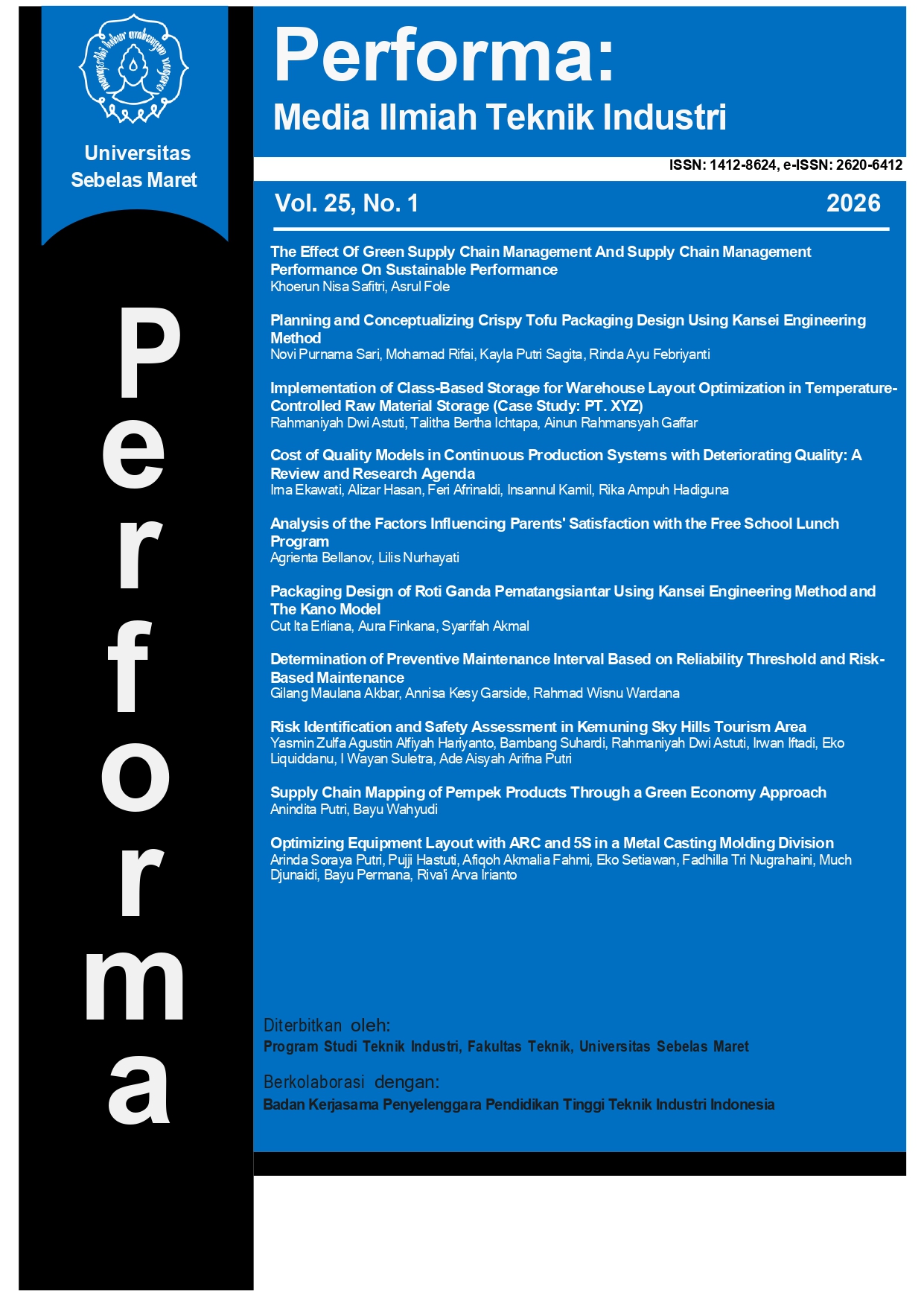
Risk Identification and Safety Assessment in Kemuning Sky Hills Tourism Area
DOI:
https://doi.org/10.20961/performa.v25i1.2841Keywords:
Safety , Risk Assessment, HIRADC, Tourism SafetyAbstract
Kemuning Sky Hills is a natural tourist attraction in Karanganyar Regency that offers various extreme rides, including a glass bridge, a sky swing, a flying chair, and a flying bicycle. Although it attracts tourists, the safety risks associated with these rides have not been optimally managed. This study aims to assess safety risks using the Hazard Identification, Risk Assessment, and Determination of Control (HIRADC) and provide a deeper understanding of the importance of safety risk analysis in extreme tourism destinations. The risk assessment is based on the Australian Standard HB 205-2004 reference. Data were collected through direct observation, interviews with officers and visitors, and field documentation. The results showed that several potential hazards fall into the High Risk to Extreme Risk categories. There are 10 risks in the High Risk category and 4 risks in the Extreme Risk category. The most extreme risks identified include overloading due to visitor density, gaps in the fence on the Glass Bridge, broken ropes on the Sky Swing, and the threat of landslides in the tourist area. Proposed controls include installing safety nets, rope guides, and warning signs, establishing a structured maintenance schedule, and providing education. This study concludes that safety management at Kemuning Sky Hills should be strengthened by implementing an integrated, structured safety management system that includes standardized operational procedures, routine risk assessments, clear emergency response mechanisms, and continuous staff training to ensure a consistently safe and sustainable tourist environment.
References
Aliperti, G., Nagai, H., & Cruz, A. M. (2020). Communicating risk to tourists: A mental models approach to identifying gaps and misperceptions. Tourism Management Perspectives, 33, 100615. https://doi.org/10.1016/j.tmp.2019.100615
Berthanila, R., Maulana, D., & Ema Jumiati, I. (2025). Post-disaster tourism governance; public perceptions of disaster mitigation and tourism safety post-tsunami in Tanjung Lesung, Indonesia. Otoritas : Jurnal Ilmu Pemerintahan, 15(1), 72–89. https://doi.org/10.26618/ojip.v15i1.16567
Heryanto, R. M., Arisandhy, V., Suhada, K., Santoso, S., Liputra, D. T., Wawolumaja, R., Frittandi, F., Rustandi, J. O., & Carolina, V. (2025). Perancangan fasilitas produksi dan penataan stasiun kerja untuk meningkatkan kapasitas produksi boneka di pido’a sepuh collection. Jurnal Pengabdian Masyarakat Dan Aplikasi Teknologi, 4(2), 105–112. https://doi.org/10.31284/j.adipati.2025.v4i2.7681
Kennedy, E., Visser, J. T., & Flaherty, G. T. F. (2021). Free falling: characteristics and prevention of injury and death in extreme aerial sports tourists. International Journal of Travel Medicine and Global Health, 10(1), 1–3. https://doi.org/10.34172/ijtmgh.2022.01
Maharani, M. (2022). Pentingnya kesehatan dan keselamatan kerja bagi industri pariwisata. Warta Pariwisata, 20(1), 22–24. https://doi.org/10.5614/wpar.2022.20.1.06
Mulasari, S. A., Masruddin, M., Izza, A. N., Hidayatullah, F., D.P.B.M.A, F., Axmalia, A., & Tukiyo, I. W. (2020). Pengetahuan eselamatan dan kesehatan kerja (K3) pada kelompok sadar wisata di Desa Caturharjo Yogyakarta. Jurnal Berkala Kesehatan, 6(1), 31. https://doi.org/10.20527/jbk.v6i1.8355
Noviastuti, N., Sugiarto, S., & Hendratono, T. (2025). The role of operational risk management on tourist well-being in the special region of Yogyakarta. SHS Web of Conferences, 226, 01015. https://doi.org/10.1051/shsconf/202522601015
Putri, A. A. A., Purwaningsih, R., & Hartini, S. (2022). A comparison of rap-tourism method and multi attribute aggregation in sustainability assessment of tourist destination. IOP Conference Series: Earth and Environmental Science, 1098(1), 012046. https://doi.org/10.1088/1755-1315/1098/1/012046
Rachman, T. (2023). Mitigasi risiko berbasis keselamatan dan kesehatan kerja kawasan wisata Pantai Anging Mamiri Kota Makassar. Jurnal Pengabdian Kepada Masyarakat, 29(2), 182–190. https://doi.org/10.24114/jpkm.v29i2.42641
Riyanti, K. P. K., Kakaravada, I., & Ahmed, A. A. (2025). Automatic load detector design to determine the strength of pedestrian bridges using load cell sensor based on arduino. Indonesian Journal of Electronics, Electromedical Engineering, and Medical Informatics, 4(1), 15–22. https://doi.org/10.35882/ijeeemi.v4i1.138
Ruiz-Sancho, S., Viñals, M. J., Teruel, L., & Segarra, M. (2021). Security and safety as a key factor for smart tourism destinations: new management challenges in relation to health risks (pp. 511–522). https://doi.org/10.1007/978-3-030-72469-6_34
Saptadi, J. D., Arianto, M. E., & Rifai, M. (2022). Studi sarana prasarana keselamatan dan keamanan wisatawan pada destinasi wisata Pantai Parangtritis dan Pantai Baron Tahun 2021. Jurnal Formil (Forum Ilmiah) Kesmas Respati, 7(2), 132. https://doi.org/10.35842/formil.v7i2.428
Sari, N., Fajri, C., Winiarti, S., Ahdiani, U., & Zulhuda, S. (2024). The regulations of protection tourists in high-risk tourism destination. Journal of Human Rights, Culture and Legal System, 4(3), 803–821. https://doi.org/10.53955/jhcls.v4i3.366
Setyawati, E., Soecahyadi, Hasibuan, B., & Ratnasari, L. (2025). Risk analysis of Menganti Beach tourism, Kebumen District, Central Java. Testing, Psychometrics, Methodology in Applied Psychology, 32(4), 840–846. https://tpmap.org/submission/index.php/tpm/article/view/3218
Sukmana, S. D., & Prasetya, M. E. (2025). Implementation of risk management design in the tourism industry at PT XYZ, Bandung Regency, based on ISO 31000:2018. Greenation International Journal of Economics and Accounting, 3(1), 58–70. https://doi.org/10.38035/gijea.v3i1.360
Tempo. (2023, September 6). Kemuning Sky Hills di Karanganyar gaet 30 ribu pengunjung per bulan. https://travel.tempo.co/read/1771204/kemuning-sky-hills-di-karanganyar-gaet-30-ribu-pengunjung-per-bulan. https://travel.tempo.co/read/1771204/kemuning-sky-hills-di-karanganyar-gaet-30-ribu-pengunjung-per-bulan
Wirajuna, B., & Supriadi, B. (2017). Peranan kelompok sadar wisata untuk meningkatkan keamanan wisatawan: studi kasus di Jerowaru Nusa Tenggara Barat. Jurnal Pariwisata Pesona, 2(2). https://doi.org/10.26905/jpp.v2i2.1508
Yuniawan, R. A., Rifa’i, A., Faris, F., Subiyantoro, A., Satyaningsih, R., Hidayah, A. N., Hidayat, R., Mushthofa, A., Ridwan, B. W., Priangga, E., Muntohar, A. S., Jetten, V. G., Westen, C. J. van, Bout, B. V. den, & Sutanto, S. J. (2022). Revised rainfall threshold in the Indonesian landslide early warning system. Geosciences, 12(3), 129. https://doi.org/10.3390/geosciences12030129
Zhao, Z., Song, W., Wang, H., Sun, Y., & Luo, H. (2024). Development and application of IoT monitoring systems for typical large amusement facilities. Sensors, 24(14), 4433. https://doi.org/10.3390/s24144433
Zheng, C., Wu, Shufang, Teng, Y.-P., Wu, Shuzhao, & Wang, Z. (2023). Natural resources, tourism resources and economic growth: A new direction to natural resources perspective and investment. Resources Policy, 86, 104134. https://doi.org/10.1016/j.resourpol.2023.104134
Downloads
Published
Issue
Section
License
Copyright (c) 2026 Performa: Media Ilmiah Teknik Industri

This work is licensed under a Creative Commons Attribution-ShareAlike 4.0 International License.