Publication Ethics
Publication Ethics
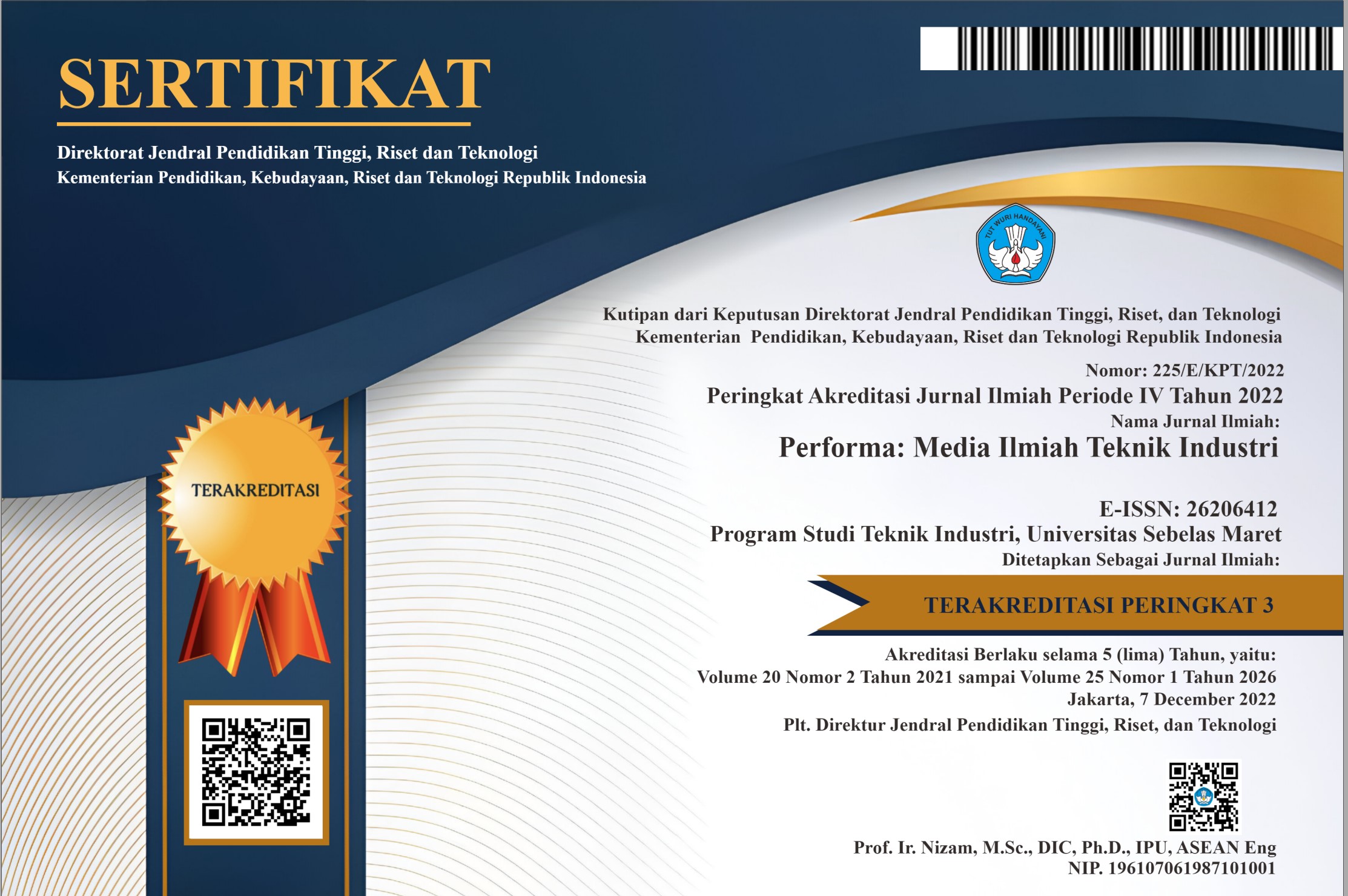
Performa: Media Ilmiah Teknik Industri (p-ISSN: 1412-8624; e-ISSN: 2620-6412) is a peer-reviewed journal published by Industrial Engineering Department, Faculty of Engineering, University of Sebelas Maret .This statement clarifies ethical behaviour of all parties involved in the act of publishing an article in this journal, including the author, the chief editor, the Editorial Board, the peer-reviewer and the publisher. This statement is based on COPE’s Best Practice Guidelines for Journal Editors.
1. Allegations of Misconduct
Performa upholds integrity in scholarly publication. Allegations of research or publication misconduct—including fabrication, falsification, plagiarism, redundant publication, manipulation of the peer review process, or undeclared conflicts of interest—will be handled according to COPE flowcharts.
All complaints or suspicions may be reported confidentially to the Editor-in-Chief. The editorial office will:
- Record and acknowledge receipt of the allegation
- Conduct an initial assessment
- Seek a response from the author(s) within a reasonable time
- If necessary, involve the author’s institution or relevant ethics committee
- Publish appropriate outcomes (correction, retraction, or expression of concern).
- Confidentiality and fairness are maintained throughout
2. Authorship and Contributorship
Authorship must be limited to individuals who have made significant contributions to the conception, design, execution, or interpretation of the study. All authors must approve the final manuscript and agree to its submission. Performa encourages transparent author contribution statements (e.g., conceptualization, methodology, analysis, writing).
Any request for addition, removal, or rearrangement of authors after submission must be approved by all co-authors and justified in writing. Disputes regarding authorship will follow COPE’s guidance
3. Complaints and Appeals
Performa provides a transparent mechanism for handling complaints about editorial conduct, decisions, or publication ethics.
- Authors may appeal an editorial decision by writing to the Editor-in-Chief within 30 days of notification, providing clear reasons and supporting evidence;
- Complaints about editorial behaviour, bias, or ethical breaches can be submitted to the Managing Editor or Faculty of Law Ethics Committee.
All appeals and complaints will be acknowledged, reviewed independently, and concluded transparently. The final decision rests with the Editor-in-Chief.
4. Conflicts of Interest
All parties—authors, reviewers, and editors—must disclose any financial, personal, or institutional relationships that could influence their work.
- Authors must declare all funding sources and potential conflicts in their manuscripts.
- Reviewers must decline assignments if a conflict exists (e.g., collaboration, competition, or personal connection).
- Editors must recuse themselves when handling manuscripts involving potential conflicts.
Disclosures will be published within the article, and any undisclosed conflict discovered post-publication may lead to correction or retraction.
5. Data and Reproducibility
Authors must ensure that data supporting the results are accurately represented and available upon reasonable request.
Performa encourages data sharing through reputable repositories and requires a Data Availability Statement in each article.
Authors are responsible for transparency in methodology and adherence to appropriate reporting guidelines. Falsification or selective reporting constitutes misconduct.
6. Ethical Oversight
Research involving human participants, animals, or sensitive data must comply with institutional and international ethical standards.
- Authors must state that ethical approval was obtained (including IRB name and reference number).
- For human research, informed consent must be obtained and participants’ privacy protected.
- For animal studies, authors must confirm compliance with ethical standards and welfare protocols.
- Failure to obtain proper ethical oversight may result in rejection or retraction.
7. Intellectual Property and Plagiarism
Performa publishes under the Creative Commons Attribution 4.0 International License (CC BY SA 4.0).
- Authors retain copyright and grant Performa the right of first publication under a Creative Commons Attribution-ShareAlike 4.0 International License (CC BY-SA 4.0).
- All submissions are screened with plagiarism-detection software (Turnitin).
- Plagiarism, duplicate or redundant publication, and self-plagiarism are strictly prohibited. Submissions exceeding the similarity threshold or reproducing copyrighted material without permission will be rejected or retracted.
- Authors must ensure all figures, tables, and text are original or properly cited.
8. Journal Management
Performa is published by the Industrial Engineering Department, Faculty of Engineering, University of Sebelas Maret.
Editorial independence is guaranteed: commercial, institutional, or sponsor interests shall not influence editorial decisions.
The journal’s management maintains transparency in:
- Editorial board membership and responsibilities,
- Peer review procedures,
- Article processing charges and waiver policy, and
- All processes are reviewed annually to ensure compliance with COPE and national standards (SINTA accreditation).
9. Post-Publication Discussion and Corrections
Performa supports open post-publication dialogue. Readers may submit comments or letters addressing published articles. Corrections, corrigenda, errata, or retractions will be issued when errors or ethical breaches are verified.
Retractions follow COPE’s Retraction Guidelines and will clearly state the reason (e.g., error, misconduct, ethical non-compliance).
Expressions of concern may be published if investigations are ongoing. All updates remain permanently linked to the original article.