Author Guidelines
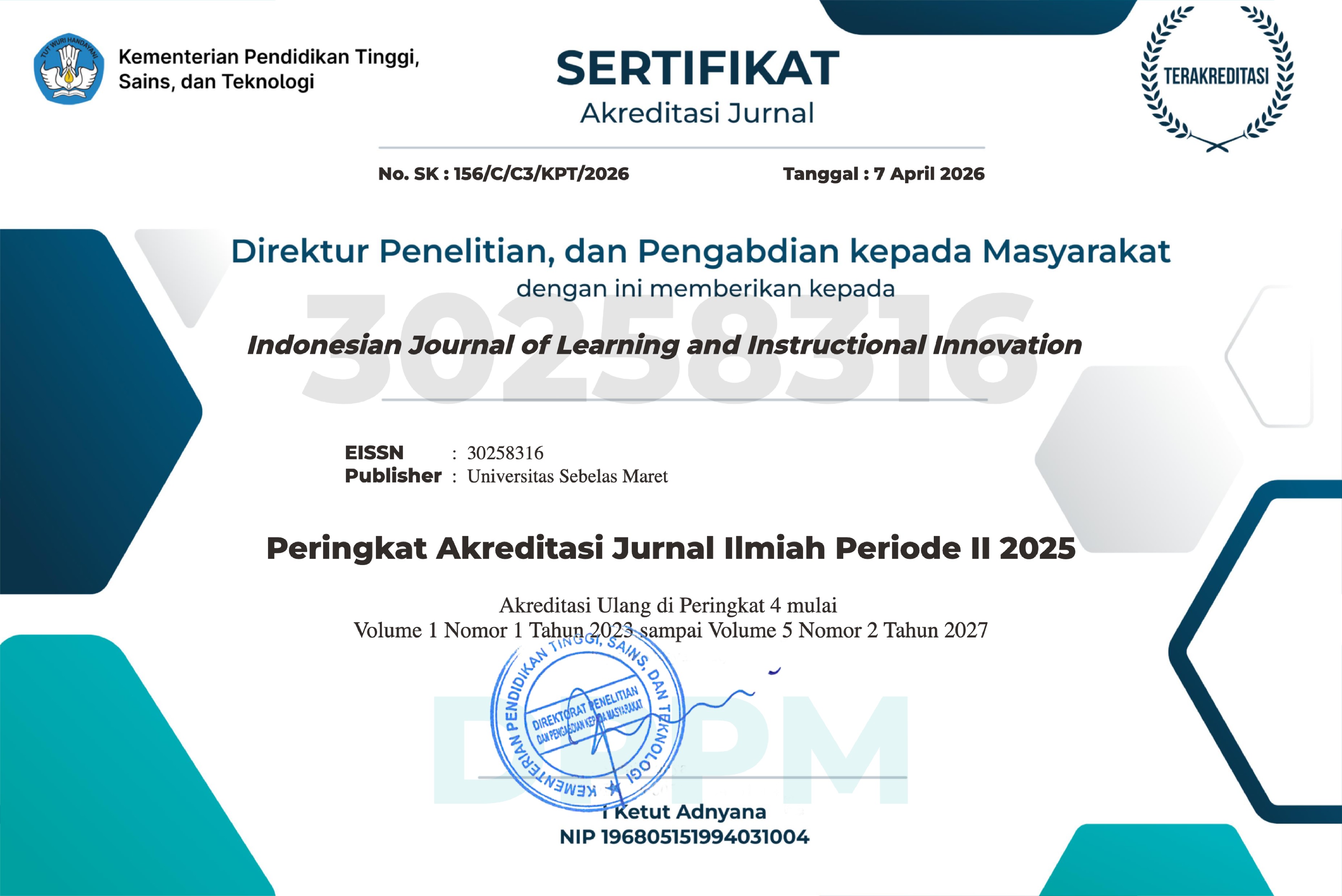
Indonesian Journal of Learning and Instructional Inovation (e-ISSN: 3025-8316) is peer reviewed journal of educational technology research which publishes reviews, analysis, dan empirical research on designing, developing, managing, utilizing and evaluating educational Technology to facilitating learning and improving performance in both formal and informal educational settings.
Focus & scope includes: Games Base Learning, Learning Media Inovation, Learning Resources Inovation, E-learning, Distance Learning, Online Learning, Learning Evaluation, Instructional Design Inovation, Instructional Models Inovation, Education and Training Development, Virtual Management System, and other relevant topics in the field of Educational Technology.
Kindly please download the template of the IJOLII.
Authors are encouraged to follow the structure and formatting as detailed below.
1. General Manuscript Requirements
-
Manuscripts must be original, unpublished, and not under consideration for publication elsewhere.
-
The manuscript should be written in English with clear, concise, and academically appropriate language.
-
File format must be in Microsoft Word (.doc or .docx) and adhere strictly to the journal's template.
-
Articles should not exceed 10 pages including tables and figures.
2. Structure of Manuscript
The manuscript should be organized in the following sequence:
-
Title (Calibri, 14pt, Capitalize Each Word)
-
Must include elements of Method, Significance, and Object (MSO).
-
-
Author(s) Information
-
Include full name, institutional affiliation, city, country, and email address.
-
Designate one corresponding author (*).
-
-
Abstract
-
Maximum 200 words, written in a single paragraph.
-
Include background, objectives, methods, results, conclusions, and contribution.
-
-
Keywords
-
Include 3–5 keywords relevant to the research.
-
-
Introduction
-
Clearly state the problem, gap analysis, research urgency, and novelty.
-
-
Methods
-
Describe design, participants, data collection, and analysis techniques.
-
-
Results and Discussion
-
Present data and interpretation; avoid redundancy. Include comparisons with existing literature.
-
-
Conclusion
-
Summarize findings conceptually; include implications and recommendations for future research.
-
-
Conflict of Interest
-
Clearly declare any conflicts.
-
-
Acknowledgements (Optional)
-
References
-
See Section 5 below for citation format and requirements.
-
3. Formatting Guidelines
-
Use Calibri font, size 11, with 1.15 line spacing.
-
Margins: Top 2.5 cm, Bottom 2.5 cm, Left 3 cm, Right 2.5 cm.
-
Tables and figures must be clearly labeled and referred to in the text.
-
Use headings and subheadings to organize content logically.
4. Submission Instructions
-
Submissions must be made via the IJOLII online submission system at: https://journal.uns.ac.id/ijolii
-
A submission checklist must be completed, and a copyright form must be signed.
5. References and Citation Style
-
Citations and references must follow the APA 7th Edition style.
-
Authors are required to use a reference management application such as:
-
Mendeley
-
EndNote
-
Zotero
The use of reference managers helps ensure accurate citation formatting and reduces editorial correction times.
-
-
At least 30 references must be included.
-
More than 80% of the cited works must be from peer-reviewed journal articles published within the last 5 years.
-
Unpublished works (e.g., theses, reports not accessible to the public) should be avoided.
Example Reference Format:
| Type of Source | Example (APA 7th Edition) |
|---|---|
| Journal Article (with DOI) | Wahyudi, M. N. A., Budiyanto, C. W., Widiastuti, I., & Pambudi, N. A. (2025). Beyond Points and Badges: Deepening Engagement in MOOCs through Gamification. International Journal of Interactive Mobile Technologies (iJIM), 19(01), 18-33. https://doi.org/10.3991/ijim.v19i01.51705 |
| Journal Article (without DOI) | Wahyudi, M. N. A., Budiyanto, C. W., & Bakar, M. S. b. (2024). Soil Temperature and Moisture Forecasting Using Exponential Smoothing Method Based on Mean Absolute Percentage Error. IJAI (Indonesian Journal of Applied Informatics), 8(2), 10. |
| Book | Creswell, J. W. (2014). Research design: Qualitative, quantitative, and mixed methods approaches (4th ed.). SAGE Publications. |
| Book Chapter | Reiser, R. A. (2001). A history of instructional design and technology. In D. H. Jonassen (Ed.), Handbook of research for educational communications and technology (pp. 11–44). Lawrence Erlbaum Associates. |
| Conference Proceedings | Sukardi, S., & Putra, G. (2020). Developing blended learning based on problem solving for vocational students. In S. M. Utami (Ed.), Proceedings of the 3rd International Conference on Vocational Education and Training (ICOVET 2019) (pp. 21–27). Atlantis Press. https://doi.org/10.2991/icovet-19.2020.5 |
| Thesis or Dissertation | Firmansyah, R. (2018). The implementation of project-based learning to improve students’ creativity in science class [Master’s thesis, Universitas Negeri Surabaya]. http://repository.unesa.ac.id/id/eprint/12345 |
| Government or Organization Report | OECD. (2020). Education at a glance 2020: OECD indicators. OECD Publishing. https://doi.org/10.1787/69096873-en |
| Website | UNESCO. (2022, March 10). The role of teachers in a post-pandemic world. UNESCO.org. https://www.unesco.org/en/articles/teachers-post-pandemic |
| Online Video | Edutopia. (2019, May 6). How to use project-based learning in the classroom [Video]. YouTube. https://www.youtube.com/watch?v=LMCZvGesRz8 |
6. Ethical Considerations
-
All authors must ensure the integrity of their research.
-
Plagiarism in any form is not tolerated. Manuscripts found to contain plagiarized material will be rejected.