Publication Ethics
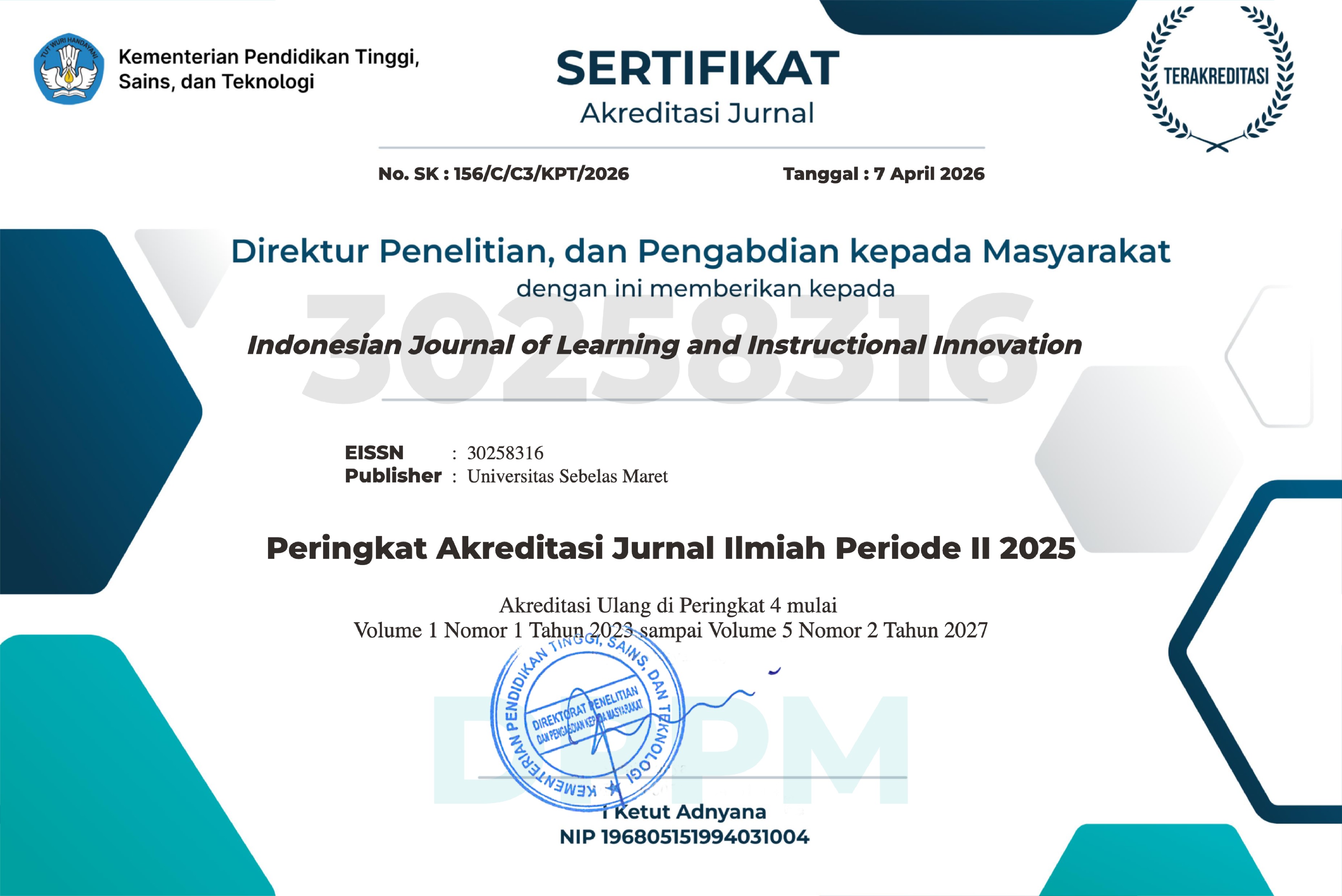
Indonesian Journal of Learning and Instructional Innovation (IJOLII) is a peer-reviewed journal. This journal follows guidelines from the Committee on Publication Ethics (COPE) in addressing all aspects of publication ethics and, in particular, how to handle cases of research and publication misconduct. This statement clarifies the ethical behavior of all parties involved in the act of publishing an article in this journal, including the author, the Editor-in-Chief, the Editorial Board, the peer-reviewer, and the publisher (Universitas Sebelas Maret, Indonesia).
Ethical Guidelines for Journal Publication
Indonesian Journal of Learning and Instructional Innovation (IJOLII) adapts COPE principles to meet high ethical standards for publishers, editors, authors, and reviewers. As a fundamental concern, publication ethics must be clearly explained to enhance the quality of global research. This section outlines the standards for editors, authors, and reviewers. Publishers are not permitted to interfere with the integrity of content and only support its timely publication.
For Editors
-
Based on the review report from the editorial board, the editor may accept, reject, or request revisions to the manuscript.
-
Editors are responsible for every article published in IJOLII.
-
Editors may consult with other editors or reviewers when making final decisions.
-
Editors must evaluate manuscripts objectively, based on their academic merit, without discrimination based on nationality, ethnicity, political belief, race, religion, gender, seniority, or institutional affiliation. They must decline their role in cases of potential conflict of interest.
-
Editors must ensure that the manuscript sent to reviewers does not contain author-identifying information, and vice versa.
-
Editorial decisions should be communicated to authors along with reviewer comments unless those comments are offensive or defamatory.
-
Editors should honor reasonable requests from authors to exclude certain individuals from reviewing their manuscript.
-
Editors and all editorial staff must maintain the confidentiality of submitted manuscripts.
-
Editors will follow COPE flowcharts in cases of suspected misconduct or disputed authorship.
For Reviewers
-
Reviewers must comment on ethical issues and possible research or publication misconduct.
-
Reviewers must work promptly and inform the editor if they are unable to complete the review.
-
Reviewers must maintain the confidentiality of the manuscript.
-
Reviewers must not accept to review manuscripts in which they have a conflict of interest with any of the authors.
For Authors
-
Authors affirm that the manuscript has not been previously published and that the rights have not been transferred elsewhere.
-
Authors must ensure the originality of their work and cite other works appropriately in the specified reference format.
-
Authors must not engage in plagiarism or self-plagiarism.
-
Authors must adhere to the authorship criteria outlined in the IJOLII author guidelines.
-
Authors must not submit the same manuscript to more than one journal simultaneously. Redundant or duplicate publication is prohibited.
-
Authorship must be limited to individuals who made significant contributions to the conception, design, execution, or interpretation of the study. Others must be listed as co-authors. All listed authors must have reviewed and approved the final manuscript.
-
Authors must not include personal information that may identify a patient in any form (text, image, or pedigree).
-
Authors must provide editors with access to research data upon suspicion of falsification or fabrication.
-
Authors must report any significant error or inaccuracy found after submission to the editor immediately.
-
Authors must disclose all potential conflicts of interest, including funding sources, consultancy fees, and intellectual property, using the IJOLII disclosure form.
Disclaimer
The Editors of Indonesian Journal of Learning and Instructional Innovation (IJOLII) make every effort to ensure the accuracy of all information (“the Content”) published in the journal. However, the Editors make no representations or warranties regarding the accuracy, completeness, or suitability of the Content for any purpose and disclaim all such representations and warranties, whether express or implied, to the maximum extent permitted by law. Any views expressed in this publication are those of the authors and do not necessarily reflect those of the Editors or IJOLII.