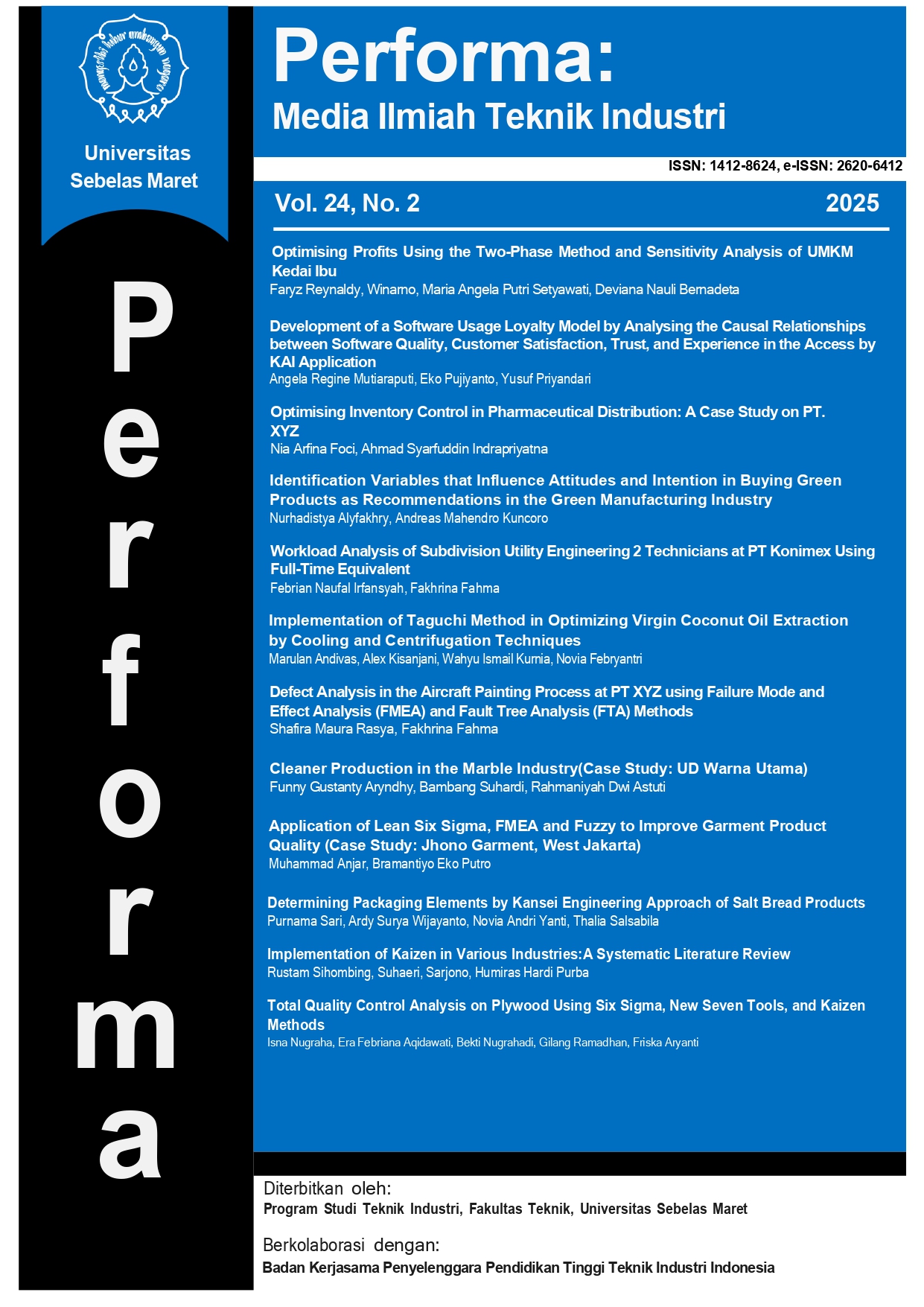
Workload Analysis of Subdivision Utility Engineering 2 Technicians at PT Konimex Using Full-Time Equivalent
DOI:
https://doi.org/10.20961/performa.v24i2.2740Keywords:
Full-Time Equivalent, Human Resource Evaluation, Productivity, Technician, WorkloadAbstract
Rapid technological advancement significantly impacts various aspects of life, including company productivity. Company productivity is closely related to human resources. A crucial aspect of human resources in enhancing company productivity is the workload received by employees. PT Konimex is a company planning to implement a new corporate strategy to face Industry 4.0 globalization, which requires evaluating human resources. This study aims to analyze the workload of technicians in the Utility Engineering 2 sub-department at PT Konimex using the Full Time Equivalent (FTE) method and to provide improvement recommendations to optimize workload. Full-time Time Equivalent (FTE) is used to calculate the amount of time required by workers to complete activities within a specific period. To calculate FTE, employee activity and time usage data are required. Therefore, data collection is conducted by compiling the company's historical records and conducting interviews with technicians. After performing calculations, a fishbone diagram is used to analyze the problem and identify alternative solutions. The results show significant variations in FTE values among technicians. Technician Officer A, Technician Level 1 A, and Technician Level 1 B are in an overload condition, Technician Officer B, Technician Level 4 B, and the Head Technician are underloaded. At the same time, Technician Level 1 C and Technician Level 4 A have a normal workload. Improvement recommendations include scheduling preventive maintenance work, optimizing overtime only for critical situations, adhering to work distribution procedures according to SOPs, developing work report input templates, and evaluating preventive maintenance activities
References
Ahmad, A., Herdianzah, Y., Safutra, N.I., Rauf, N., Gamgulu, R., Nur, T. (2023). Workload Analysis To Determine The Optimal Number Of Workforce Using The Work Load Analysis (WLA) Method At PT. Harapan Jaya Multi Bisnis. OPSI, 16(2), 241-249.
Danuri, M. (2019). Perkembangan Dan Transformasi Teknologi Digital.INFOKAM, 2, 116-123.
Hudaningsih, N & Prayoga, R. (2019). Analisis Kebutuhan Karyawan Dengan Menggunakan Metode Full Time Equivalent (Fte) Pada Departemen Produksi Pt. Borsya Cipta Communica. Jurnal TAMBORA, 3(2), 98-106.
Kurniawan, H., Yulianah, Shaura, R.K. (2022). Workload Analysis Using the Full Time Equivalent (FTE) Method to Optimizing Labor. Enrichment : Journal of Management, 12(4), 3058-3066.
Maretno, A. & Haryono. (2015). Analisa Beban Kerja Fisik dan Mental dengan Menggunakan Work Sampling dan NASA-TLX Untuk Menentukan Jumlah Operator. Dinamika Rekayasa, 11(2), 54-62.
Muchlisin, M.N. (2021). Work Load Analysis dengan Full Time Equivalent Sebagai Pertimbangan Pembagian Beban Kerja Karyawan. Psyche 165 Journal, 14(2), 233-238.
Pambudi, YW. (2017). Analisis Beban Kerja Karyawan dengan Metode Full Time Equivalent (Studi Kasus UKM Unlogic Projeck). Teknik Industri, Fakultas Teknologi Industri, Universitas Islam Indonesia Yogyakarta.
Sari, A.D., Hardiansa, F., Suryoputro, M.R. (2018). Workload Assesment On Foundry Sme To Enchance Productivity Using Full Time Equivalent. MATEC Web of Conferences, 154.
Setiowati, N.O., Zamzani, M.I., Nurdiono, D. (2023). Determination of Physical Workload and the Ideal Number of Workers in Arsy Bakery using Full Time Equivalent (FTE) Method. SURYA TEKNIKA, 10(1), 552-555
Sugiharjo, R. & Aldata, F. (2018). Pengaruh Beban Kerja Dan Motivasi Kerja Terhadap Kinerja Karyawan Bpjs Ketenagakerjaan Cabang Salemba. Jurnal Ilmiah Manajemen Bisnis, 4(1), 128-137.
Sukirman, Mashabai, I., Adiasa, I. (2021). Analisis Beban Kerja Pekerja Pada Gedung 1 Departemen Produksi Pt. Sunthi Sepuri Menggunakan Metode Full Time Equivalen (FTE). Performa : Media Ilmiah Teknik Industri, 20(1), 21-28.
Sunaryo, M & Ratriwardhani, R.A. (2022). The effect of workload and length of work on the occurrence of fatigue in workers in the informal industry. Bali Medical Journal, 11 (1), 310-314.
Tague, N.R. (2023). The Quality Toolbox Second Edition. Milwaukee : American Society for Quality, 247-249.
Widagdo, G.U. (2018). Analisis Perhitungan Waktu Baku Dengan Menggunakan Metode Jam Henti Pada Produk Pulley Di Cv. Putra Mandiri Jakarta. Jurnal PASTI, 12(1), 120-137.
Widyaningrum, S, Asepta, U.Y., Darmadi, S.I., Geofani, V.A. (2023). Analisis Beban Kerja Menggunakan Metode Full Time Equivalent Divisi Quality Control PT Beiersdorf Indonesia. Jurnal Ilmiah Manajemen dan Bisnis, 6(2), 1056-1063.
Wijaya, S.M., Nugraha, R.B.A., Setiawan, E.A. (2024). Full Time Equivalent Sebagai Acuan Dalam Penentuan Jumlah Tenaga Kerja. Jurnal Teknologi dan Manajemen Industri Terapan, 3(2), 125-133.
Yusnindar, Y. & Darmawan, D. (2021). Analisis Pengaruh Perencanaan Sumber Daya Manusia Terhadap Produktivitas Kerja Karyawan Pt. Telkom Divisi Acces Kota Lhokseumawe. Asia-Pacific Journal of Public Policy, 7(2), 82-93
Downloads
Published
Issue
Section
License
Copyright (c) 2025 Performa: Media Ilmiah Teknik Industri

This work is licensed under a Creative Commons Attribution-NonCommercial-ShareAlike 4.0 International License.