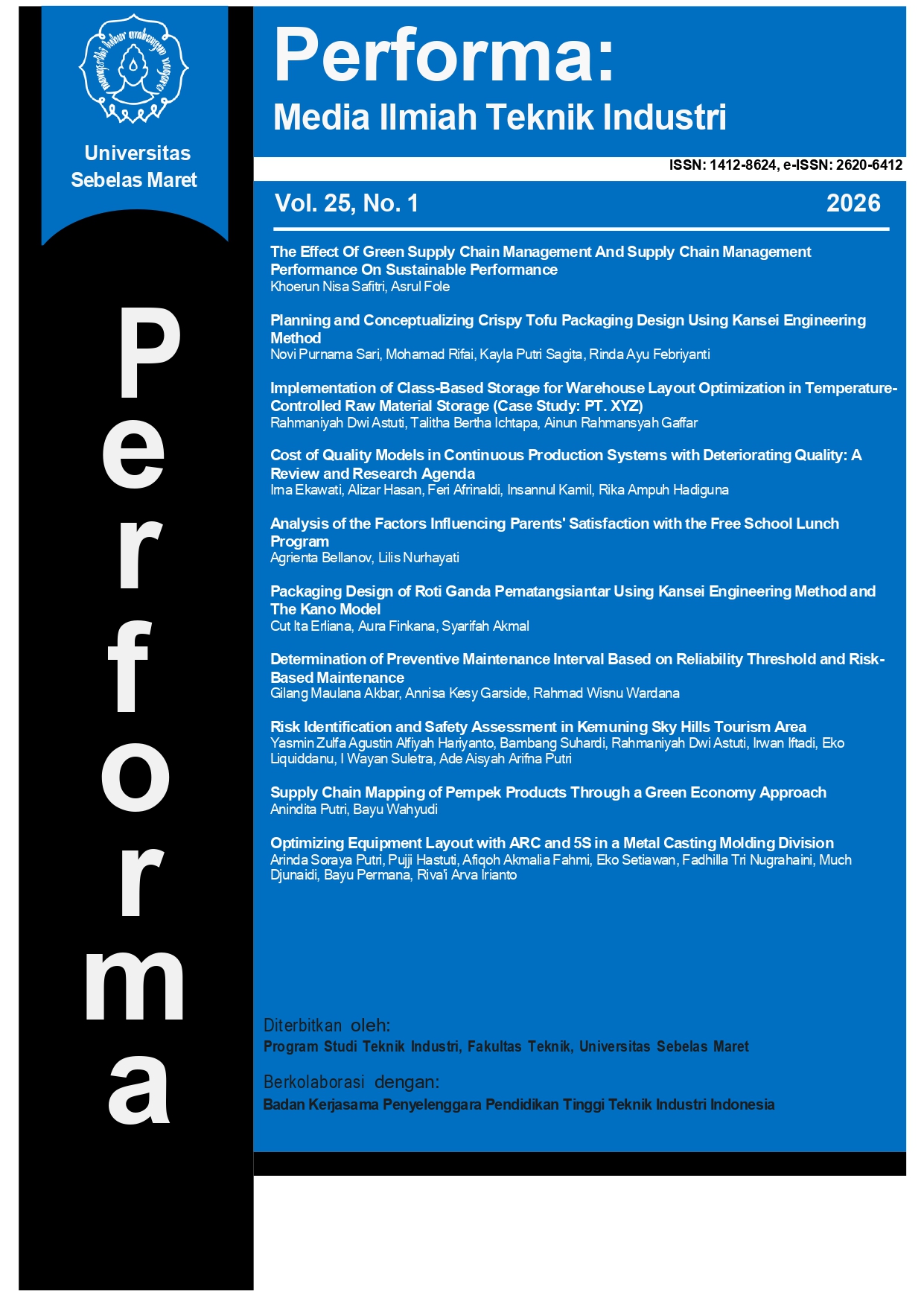
The Effect Of Green Supply Chain Management And Supply Chain Management Performance On Sustainable Performance
DOI:
https://doi.org/10.20961/performa.v25i1.2749Keywords:
Green Supply Chain Management, Supply Chain Performance, Sustainable Performance, Environmental Impact, Structural Equation ModelingAbstract
This research analyzes the influence of Green Supply Chain Management (Green SCM) and Performance Supply Chain Management (Performance SCM) variables on environmental, economic and social dimensions, as well as their impact on sustainable performance. The confirmatory test results show that the construct indicators used are significant for measuring both endogenous and exogenous latent variables. The estimation method applied is maximum likelihood (ML), which searches for optimal parameters to produce the highest covariance. The proposed model meets most of the goodness of fit criteria, although it is not fit according to the chi square criteria, but is considered feasible based on the existing consensus. Hypothesis testing shows that Green SCM has a positive effect on the environment, economy and social. On the other hand, SCM Performance has no significant effect on the economy. Further analysis indicates that 43.5% of the economic variables can be explained by Green SCM and Performance SCM, while the remaining 56.5% is influenced by other factors. These findings emphasize the importance of implementing Green SCM in supporting sustainable performance.
References
Abualigah, L., Hanandeh, E. S., Zitar, R. A., Thanh, C.-L., Khatir, S., & Gandomi, A. H. (2023). Revolutionizing sustainable supply chain management: A review of metaheuristics. Engineering Applications of Artificial Intelligence, 126, 106839. https://doi.org/10.1016/j.engappai. 2023.106839
Adwiyah, R., Syaukat, Y., Indrawan, D., & Mulyati, H. (2023). Examining Sustainable Supply Chain Management (SSCM) Performance in the Palm Oil Industry with the Triple Bottom Line Approach. Sustainability, 15(18), 13362. https://doi.org/ 10.3390/su151813362
Alhammadi, Y., Radzi, A. R., Alias, A. R., & Rahman, R. A. (2024). Modeling Workplace Well-Being Factors in Infrastructure Construction Projects: PLS-SEM Approach. Buildings, 14(8), 1–20. https://doi.org/10.3390/buildings14082289
Ali, S. R., Al masud, A., Hossain, Md. A., Islam, K. M. Z., & Shafiul Alam, S. M. (2024). Weaving a greener future: The impact of green human resources management and green supply chain management on sustainable performance in Bangladesh’s textile industry. Cleaner Logistics and Supply Chain, 10, 100143. https://doi.org/10.1016/j.clscn.2024.100143
Asnidar, Fole, A., Malik, R., & Ahmad, A. (2024). Performance Measurement of Green Manufacturing in the Refined Sugar Industry Using the Green Supply Chain Operation Reference Approach at PT. ABC. Journal of Industrial System Engineering and Management, 3(2), 55–65. https://doi.org/10.56882/jisem.v3i2. 38
Bu, X., Dang, W. V. T., Wang, J., & Liu, Q. (2020). Environmental Orientation, Green Supply Chain Management, and Firm Performance: Empirical Evidence from Chinese Small and Medium-Sized Enterprises. International Journal of Environmental Research and Public Health, 17(4), 1199. https://doi.org/10.3390/ijerph17041199
Dzikriansyah, M. A., Masudin, I., Zulfikarijah, F., Jihadi, M., & Jatmiko, R. D. (2023). The role of green supply chain management practices on environmental performance: A case of Indonesian small and medium enterprises. Cleaner Logistics and Supply Chain, 6, 100100. https://doi.org/10.1016/j.clscn.2023.100100
Frederico, G. F., Garza-Reyes, J. A., Kumar, A., & Kumar, V. (2021). Performance measurement for supply chains in the Industry 4.0 era: a balanced scorecard approach. International Journal of Productivity and Performance Management, 70(4), 789–807. https://doi.org/10.1108/IJPPM-08-2019-0400
Gera, R., Yadav, R., Khera, G., Saxena, A., Chadha, P., Dixit, S., & Yuliya Sergeevna, L. (2022). A systematic literature review of supply chain management practices and performance. Materials Today: Proceedings, 69, 624–632. https://doi.org/10.1016/j.matpr.2022.10.203
Habib, M. A., Balasubramanian, S., Shukla, V., Chitakunye, D., & Chanchaichujit, J. (2022). Practices and performance outcomes of green supply chain management initiatives in the garment industry. Management of Environmental Quality: An International Journal, 33(4), 882–912. https://doi.org/10.1108/MEQ-08-2021-0189
Hariyani, D., Hariyani, P., Mishra, S., & Sharma, M. K. (2024). A literature review on green supply chain management for sustainable sourcing and distribution. Waste Management Bulletin, 2(4), 231–248. https://doi.org/10.1016/j.wmb.2024.11. 009
Herdianzah, Y., Ahmad, A., Chantika, A. M. D., Saleh, A., Fole, A., & Safutra, N. I. (2024). Factors that influence worker behavior towards occupational safety and health using the SEM-PLS method at PT. Industri Kapal Indonesia (Persero) Makassar. OPSI, 17(2), 327–337. https://doi.org/10.31315/opsi.v17i2.11211
Khan, M. T., Idrees, M. D., Rauf, M., Sami, A., Ansari, A., & Jamil, A. (2022). Green Supply Chain Management Practices’ Impact on Operational Performance with the Mediation of Technological Innovation. Sustainability, 14(6), 3362. https://doi.org/10.3390/su14063362
Kulsaputro, J., Fole, A., Safitri, K. N., & Aini, N. (2025). The Role of Resilient Supply Chains in Enhancing Competitiveness and Performance of SMEs: A Case Study in the SMI Sector. Jurnal Serambi Engineering, 10(2), 13205–13211. https://jse.serambimekkah.id/index.php/jse/article/view/865
Kumar, A., Shrivastav, S. K., Shrivastava, A. K., Panigrahi, R. R., Mardani, A., & Cavallaro, F. (2023). Sustainable Supply Chain Management, Performance Measurement, and Management: A Review. Sustainability, 15(6), 5290. https://doi.org/10.3390/su15065290
Kumar, K. N. R., Konduru, S., Chandrasekhara, P., & Babu, S. C. (2021). Restructuring State Intervention Strategies towards Chickpea Production Development in India—Application of Structural Equation Modeling (SEM). Sustainability, 13(18), 10283. https://doi.org/10.3390/su131810283
Kumar Shetty, S., & Subrahmanya Bhat, K. (2022). Green supply chain management practices implementation and sustainability –A review. Materials Today: Proceedings, 52, 735–740. https://doi.org/10.1016/j.matpr.2021.10.135
Lin, C.-Y., Alam, S. S., Ho, Y.-H., Al-Shaikh, M. E., & Sultan, P. (2020). Adoption of Green Supply Chain Management among SMEs in Malaysia. Sustainability, 12(16), 6454. https://doi.org/10.3390/su12166454
Machado, M. C., Correa, V. S., Queiroz, M. M. de, & Costa, G. C. (2023). Can Global Reporting Initiative reports reveal companies’ green supply chain management practices? Journal of Cleaner Production, 383, 135554. https://doi.org/10.1016/j.jclepro.2022.135554
Mail, A., Chairany, N., & Fole, A. (2019). Evaluation of Supply Chain Performance through Integration of Hierarchical-Based Measurement System and Traffic Light System: A Case Study Approach to Iron Sheet Factory. International Journal of Supply Chain Management, 8(5), 79–85. https://doi.org/10.59160/ijscm.v8i5.2584
Nahason, A., Pricilia, A., Senduk, N. T. J., & Chandra, Y. U. (2024). The Benefits and Challenges of IoT in Supply Chain Management Based on SCOR Model for Innovation in Technology. 2024 3rd International Conference for Innovation in Technology (INOCON), 1–7. https://doi.org/10.1109/INOCON60754.2024.10512342
Nguyen, T. A. T., Nguyen, T. L., Nguyen, Q. T. T., Nguyen, K. A. T., & Jolly, C. M. (2023). Measuring Supply Chain Performance for Khanh Hoa Sanest Soft Drink Joint Stock Company: An Application of the Supply Chain Operations Reference (SCOR) Model. Sustainability, 15(22), 16057. https://doi.org/10.3390/su152216057
Ning, J., Liu, B., Xu, Y., & Yu, L. (2025). Does green supply chain management improve corporate sustainability performance? Evidence from China. Environmental Impact Assessment Review, 112, 107828. https://doi.org/10.1016/j.eiar.2025.107828
Özkanlısoy, Ö., & Bulutlar, F. (2023). Measuring Supply Chain Performance as SCOR v13.0-Based in Disruptive Technology Era: Scale Development and Validation. Logistics, 7(3), 65. https://doi.org/10.3390/logistics7030065
Rahman, T., Ali, S. M., Moktadir, Md. A., & Kusi-Sarpong, S. (2020). Evaluating barriers to implementing green supply chain management: An example from an emerging economy. Production Planning & Control, 31(8), 673–698. https://doi.org/10.1080/09537287.2019.1674939
Rodríguez Mañay, L. O., Guaita-Pradas, I., & Marques-Perez, I. (2022). Measuring the Supply Chain Performance of the Floricultural Sector Using the SCOR Model and a Multicriteria Decision-Making Method. Horticulturae, 8(2), 168. https://doi.org/10.3390/horticulturae8020168
Rosyidah, M., Khoirunnisa, N., Rofiatin, U., Asnah, A., Andiyan, A., & Sari, D. (2022). Measurement of key performance indicators Green Supply Chain Management (GSCM) in the palm industry with the green SCOR model. Materials Today: Proceedings, 63, S326–S332. https://doi.org/10.1016/j.matpr.2022.03.158
Runtuk, J. K., Ng, P. K., Ooi, S. Y., Vikaliana, R., Iskandar, Y. A., Abdillah, M., & Sukarno, I. (2024). Resolving contradictions in green supply chain management: A combined TRIZ and DEMATEL approach. Cleaner Logistics and Supply Chain, 13, 100195. https://doi.org/10.1016/j.clscn.2024.100195
Safitri, K. N., Fole, A., Aini, N., & Negara, P. P. S. (2025). Strategies for Enhancing Supply Chain Efficiency in the Agricultural Sector Through the Implementation of the SCOR Racetrack Method. Agroindustrial Technology Journal, 9(1), 90–100. https://doi.org/10.21111/atj.v9i1.14299
Siems, E., Land, A., & Seuring, S. (2021). Dynamic capabilities in sustainable supply chain management: An inter-temporal comparison of the food and automotive industries. International Journal of Production Economics, 236, 108128. https://doi.org/10.1016/j.ijpe.2021.108128
Stephen, S. S., Oke, A. E., Aigbavboa, C. O., Akinradewo, O. I., Adetoro, P. E., & Ikuabe, M. (2025). Supply Chain Management for Stealth Construction. In Stealth Construction: Integrating Practices for Resilience and Sustainability (pp. 99–127). Emerald Publishing Limited. https://doi.org/10.1108/978-1-83608-182-120251005
Susanty, A., Purwanggono, B., & Situmorang, L. A. (2023). Contextual relationships among barriers to implement Green Supply Chain Management: An integrated DEMATEL and ISM approach. Procedia Computer Science, 224, 288–295. https://doi.org/10.1016/j.procs.2023.09.039
Tseng, M.-L., Bui, T.-D., Lim, M. K., Fujii, M., & Mishra, U. (2022). Assessing data-driven sustainable supply chain management indicators for the textile industry under industrial disruption and ambidexterity. International Journal of Production Economics, 245, 108401. https://doi.org/10.1016/j.ijpe.2021.108401
Vegter, D., van Hillegersberg, J., & Olthaar, M. (2023). Performance measurement system for circular supply chain management. Sustainable Production and Consumption, 36, 171–183. https://doi.org/10.1016/j.spc.2023.01.003
Yao, J., Gong, R., Long, H., & Liu, X. (2025). Analysis of the Factors Influencing Grain Supply Chain Resilience in China Using Bayesian Structural Equation Modeling. Sustainability, 17(7), 3250. https://doi.org/10.3390/su17073250
Zain, R. M., Ramli, A., Zain, M. Z. M., Rahim, M. N. A., & Musa, A. (2023). Evaluation and prioritisation of GSCM barriers in food and beverage SMEs using the AHP. 030057. https://doi.org/10.1063/5.0164583
Downloads
Published
Issue
Section
License
Copyright (c) 2026 Performa: Media Ilmiah Teknik Industri

This work is licensed under a Creative Commons Attribution-ShareAlike 4.0 International License.