Socio-Scientific Issues (SSI) Approach Implementation to Enhance Students' Creative Thinking Skills: Literature Review
DOI:
https://doi.org/10.20961/ijolii.v3i2.3006Keywords:
Creative thinking skills, literature review, socio scientific issuesAbstract
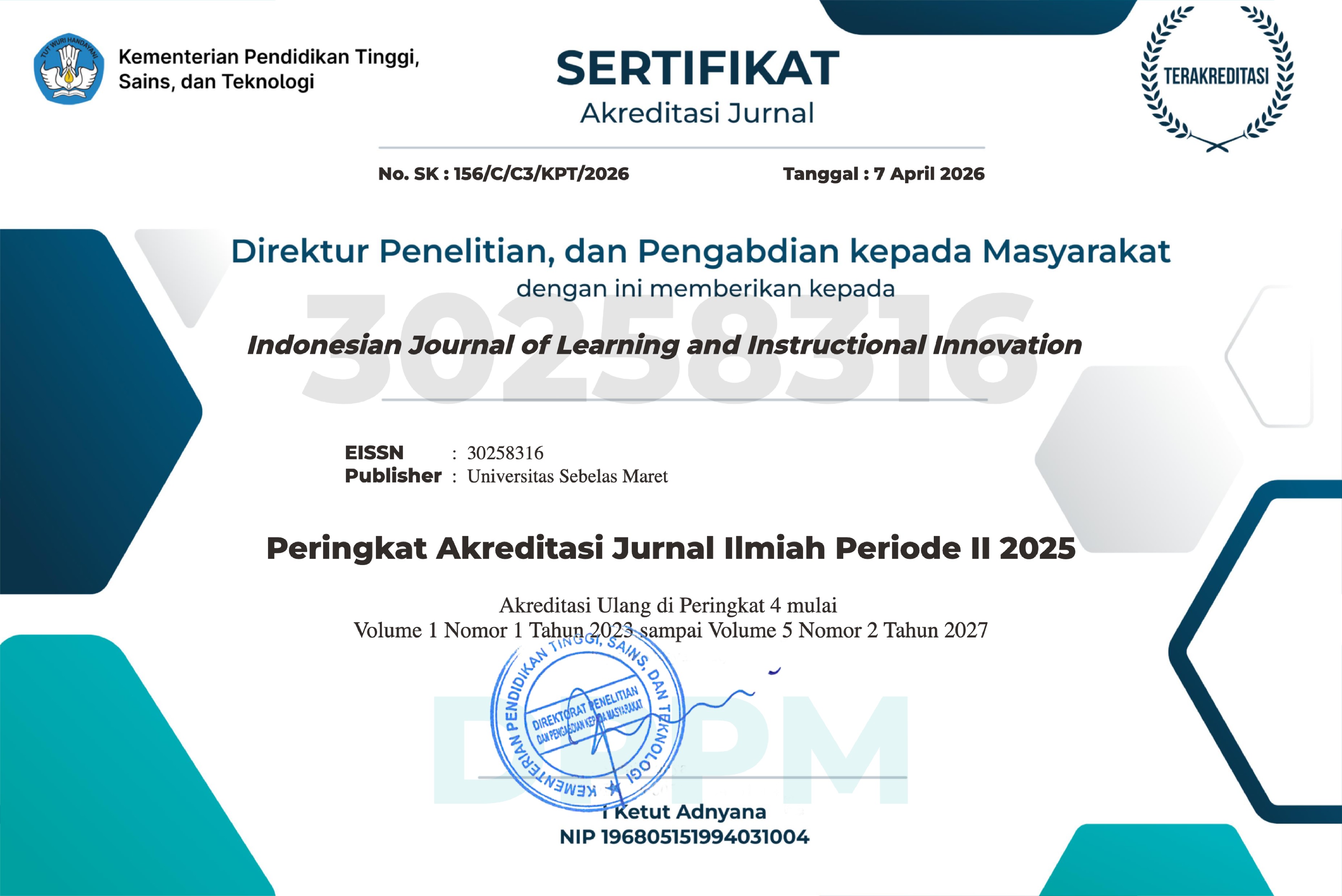
Creative thinking skills are one of the 21st-century skills that students must possess. This study aims to analyze the implementation of the Socio-Scientific Issues (SSI) approach to improve students' creative thinking skills. The study identified gaps between textbook content and actual student misconceptions in the Indonesian context. The research method used a literature review of scientific articles that align with the research objectives. Scientific articles were sorted using the Publish or Perish (PoP) application version 8 and selected based on the publication period between January 2021 and December 2025, published in journals indexed by Sinta 1 and Sinta 5 and not as a literature review. Three articles were obtained that met the selection criteria and met the article quality assessment. The results of the study indicate that there is a positive impact of implementing the SSI approach on improving students' creative thinking skills. The subject matter taught includes environmental change and conservation as well as green chemistry. The SSI approach can be applied to various learning models, namely Interactive Socio-Scientific Inquiry (ISSI), Problem-Based Learning (PBL), and Project-Based Learning (PjBL).
References
Akram, T. M., & Rana, R. A. (2025). Assessing Prospective Science Teachers' Creative Thinking Ability to Solve Environmental Issues in Higher Education. Qlantic Journal of Social Sciences and Humanities, 6(1), 254–265. https://doi.org/10.55737/qjssh.vi-i.25314
Alfaruqi, AZ & Nurwahidah. (2025). Reflection on Indonesia's PISA Scores and the 2024 Madrasah Teacher Competency Assessment Results: Challenges in Enhancing Teacher Competence. Jurnal Pendidikan IPS, 15(1), 11–19. https://doi.org/10.37630/jpi.v15i1.2559
Andaresta, DA, & Irawan, E. (2025). Study of Students' Creative Thinking Ability in Socio-Scientific Issues Integrated Science Learning. Jurnal Pendidikan Dan Pembelajaran IPA Indonesia, 15(1), 13–24. https://doi.org/10.23887/jppii.v15i1.90153
Anwar, NP, & Ali, MA (2020). The effect of socio-scientific issue (SSI) based discussion: A student-centred approach to the teaching of argumentation. Scholarship of Teaching and Learning in the South, 4(2), 35–62. https://doi.org/10.36615/sotls.v4i2.76
Arifin, S., & Nyet, MS (2024). The Effect of Socioscientific Issues Approach and Design Thinking on Entrepreneural Creative Thinking Among Secondary School Students. International Journal of Modern Education, 6(21), 611–631. https://doi.org/10.35631/IJMOE.621045
Arthamena, V.D., Ayubi, M., Atun, S., & Suyanta, S. (2024). Use of Socio-Scientific Issues in Chemistry Learning. Journal of Science Education Research, 10(1), 38–46. https://doi.org/10.29303/jppipa.v10i1.6285
Astari, WY, Redhana, IW, & Tika, IN (2025). Implications of the Socio-Scientific Issues Approach on Students' Creative Thinking Skills in Science Learning: A Systematic Literature Review. Journal of Science Education Research, 11(10), 98–106. https://doi.org/10.29303/jppipa.v11i10.12071
Beaty, R.E., Kenett, Y.N., Christensen, A.P., Rosenberg, M.D., Benedek, M., Chen, Q., Fink, A., Qiu, J., Kwapil, T.R., Kane, MJ, & Silvia, P.J. (2018). Robust prediction of individual creative ability from brain functional connectivity. Proceedings of the National Academy of Sciences, 115(5), 1087–1092. https://doi.org/10.1073/pnas.1713532115
Desstya, A., Sayekti, IC, Rahmawati, FP, Hidayati, YM, Kaltsum, HU, Mahya, YMZ, Kamila, SJP, Khotimah, NA, Fidyastuti, N., & Diaz, AM (2024). Development of a Natural and Social Sciences Learning Model Based on Socio Scientific Issues to Strengthen Scientific Literacy of Islamic Elementary School Students. Journal of Science Education Research, 10(11), 8703–8711. https://doi.org/10.29303/jppipa.v10i11.9094
Dewi, CA, & Yahdi, Y. (2025). Research Trends on Socio-Scientific Issues in Chemistry Learning: A Systematic Review. Jurnal Pendidikan MIPA. https://doi.org/10.23960/jpmipa.v26i1.pp457-475
Dewra, Dr. S. D., & Singh, J. (2025). Innovative Approaches in Modern Education: Bridging Theory and Practice. International Journal of Scientific Research in Engineering And Management, 09(05), 1–9. https://doi.org/10.55041/IJSREM46731
Dilekçi, A., & Karatay, H. (2023). The Effects Of The 21st Century Skills Curriculum On The Development Of Students' Creative Thinking Skills. Thinking Skills and Creativity. https://doi.org/10.1016/j.tsc.2022.101229
Durak, B., & Topçu, M. (2021). Socio-Scientific Issues and Model-Based Learning. IGI Global Scientific Publishing. 279–297. https://doi.org/10.4018/978-1-7998-4558-4.ch010
Dusturia, N., Nurohman, S., & Wilujeng, I. (2024). Socio-Scientific Issues (SSI) Approach Implementation in Science Learning to Improve Students' Critical Thinking Skills: Systematic Literature Review. Journal of Science Education Research, 10(3), 149–157. https://doi.org/10.29303/jppipa.v10i3.6012
Fernández-Huetos, N., Pérez-Martín, J.M., Guevara-Herrero, I., & Esquivel-Martín, T. (2025). Primary-Education Students' Performance in Arguing About a Socioscientific Issue: The Case of Pharmaceuticals in Surface Water. Sustainability, 17(4), 1618. https://doi.org/10.3390/su17041618
Foster, N., & Schleicher, A. (2022). Assessing Creative Skills. Creative Education, 13(01), 1–29. https://doi.org/10.4236/ce.2022.131001
Fujinami, K., Shimomae, K., Shimada, K., & Isozaki, T. (2025). Incorporating Socio-Scientific Issues in Science Classes: Co-Teaching with a Social Studies Teacher. Research in Science Education, 55(4), 1005–1028. https://doi.org/10.1007/s11165-025-10270-0
Hogan, D., & O'Flaherty, J. (2021). Addressing Education for Sustainable Development in the Teaching of Science: The Case of a Biological Sciences Teacher Education Program. Sustainability, 13(21), 12028. https://doi.org/10.3390/su132112028
Högström, P., Gericke, N., Wallin, J., & Bergman, E. (2025). Teaching Socioscientific Issues: A Systematic Review. Science & Education, 34(5), 3079–3122. https://doi.org/10.1007/s11191-024-00542-y
Indriani, T., Nur, U., & Dwi, A. (2022). Interactive Socio-Scientific Inquiry: The Effects on Creative Thinking Skills. Journal of Mathematics and Natural Sciences Education, 23(8), 995–1005. https://doi.org/http://dx.doi.org/10.23960/jpmipa/v23i3.pp995-1005
Karunarathne, W., & Calma, A. (2024). Assessing creative thinking skills in higher education: Deficits and improvements. Studies in Higher Education, 49(1), 157–177. https://doi.org/10.1080/03075079.2023.2225532
Ke, L., Sadler, T., Zangori, L., & Friedrichsen, P. (2020). Students' Perceptions of Socio-Scientific Issue-Based Learning and Their Appropriation of Epistemic Tools for Systems Thinking. International Journal of Science Education, 42, 1339–1361. https://doi.org/10.1080/09500693.2020.1759843
Ke, L., Sadler, T., Zangori, L., & Friedrichsen, P. (2021). Developing and Using Multiple Models to Promote Scientific Literacy in the Context of Socio-Scientific Issues. Science & Education, 30, 589–607. https://doi.org/10.1007/s11191-021-00206-1
Lubis, SPW, Suryadarma, I., Paidi, P., & Yanto, BE (2022). The Effectiveness of Problem-based learning with Local Wisdom oriented to Socio-Scientific Issues. International Journal of Instruction. https://doi.org/10.29333/iji.2022.15225a
Mulyono, Y., Yamtinah, S., & Sarwanto, S. (2023). Development of Critical and Creative Thinking Skills Instruments Based on Environmental Socio-Scientific Issues. International Journal of Instruction, 16(3), 691–710. https://doi.org/10.29333/iji.2023.16337a
Nadlifah, P., Nita, T., & Nada, EI (2024). Efektivitas Model Problem Based Learning Berbasis Socio Scientific Issue Terhadap Keterampilan Berpikir Kreatif Siswa Materi Kimia Hijau. Journal of Chemical Education Research. 14(2), 136–143. https://doi.org/10.21009/JRPK.142.08
Naitul, M., Arsih, F., & Padang, UN (2025). The Effectiveness of PjBL-Socioscientific Issues-Based Student Worksheets on Environmental Change and Conservation Material on the Creative Thinking Skills of High School/Islamic High School Students. 4(2), 56–63.
Nugroho, A., Sajidan, S., Suranto, S., & Masykuri, M. (2025). The Effects of Socio-Scientific Inquiry Based Learning on Students' Problem-Solving Skills. Journal of Baltic Science Education. https://doi.org/10.33225/jbse/25.24.149
Owens, D., & Sadler, T. (2023). Socio‐Scientific Issues Instruction for Scientific Literacy: 5E Framing to Enhance Teaching Practice. School Science and Mathematics. https://doi.org/10.1111/ssm.12626
Ritter, S. M., & Mostert, N. (2017). Enhancement of Creative Thinking Skills Using a Cognitive-Based Creativity Training. Journal of Cognitive Enhancement, 1(3), 243–253. https://doi.org/10.1007/s41465-016-0002-3
Sa'diah, C., Purwanto, A., & Koto, I. (2025). Development of E-Modules Based on Socio-Scientific Issues to Improve the Creative Thinking Skills of High School Students. Journal of Physics Learning Research, 16(2), 179–190. https://doi.org/10.26877/jp2f.v16i2.1435
Sakdiah, H., Wahdi Ginting, F., Sri Rezeki, N., & Miranda, A. (2023). The Effect of STEAM Learning and Scientific Attitude on Students' Creative Thinking Skills. Proceedings of Malikussaleh International Conference on Multidisciplinary Studies (MICoMS), 3, 00040. https://doi.org/10.29103/micoms.v3i.204
Santoso, IB, Waluyo, J., & Hariyadi, S. (2020). Effectiveness of Science Textbooks Based on Socio-Scientific Issues in Biotechnology Materials To Improve Creative Thinking Ability. International Journal of Advanced Research, 08(04), 140–144. https://doi.org/10.21474/IJAR01/10757
Sun, M., Wang, M., & Wegerif, R. (2020). Effects of divergent thinking training on students' scientific creativity: The Impact of Individual Creative Potential and Domain Knowledge. Thinking Skills and Creativity, 37, 100682. https://doi.org/10.1016/j.tsc.2020.100682
Suryani, Y., & Anggraini, W. (2025). The Effect of Socio-Scientific Issues Approach on Student Learning Outcomes in Physics Learning: A Review. MIPA Incandescent Journal. https://doi.org/10.29303/jpm.v20i3.8861
Tang, T., Vezzani, V., & Eriksson, V. (2020). Developing critical thinking, collective creativity skills and problem solving through playful design jams. Thinking Skills and Creativity, 37, 100696. https://doi.org/10.1016/j.tsc.2020.100696
Viehmann, C., Cárdenas, J. M. F., & Peña, C. G. R. (2024). The Use of Socioscientific Issues in Science Lessons: A Scoping Review. Sustainability. https://doi.org/10.3390/su16145827
Vosniadou, S. (2019). The Development of Students' Understanding of Science. Frontiers in Education, 4, 32. https://doi.org/10.3389/feduc.2019.00032
World Intellectual Property Organization. (2025, December 2). Indonesia Ranking in the Global Innovation Index 2025. WIPO. https://www.wipo.int/gii-ranking/en/indonesia
Yunita, L., & Mandasari, N. (2025). 21st-Century Skills-Oriented Science Education in the Context of Higher Education: A Review. Panthera: Scientific Journal of Science and Applied Education, 5(1), 40–49. https://doi.org/10.36312/panthera.v5i1.334
Zatdni, G.F., & Mashfufah, A. (2025). Development of Socio-scientific Issues-Based Teaching Materials on Ecosystem Materials in Elementary School. Elementary School, 5(1), 68–78. https://doi.org/10.24036/jlils.v5i1.150
Zhang, W., Sjoerds, Z., & Hommel, B. (2020). Metacontrol of Human Creativity: The Neurocognitive Mechanisms of Convergent and Divergent Thinking. NeuroImage, 210, 116572. https://doi.org/10.1016/j.neuroimage.2020.116572
Downloads
Published
Issue
Section
License
Copyright (c) 2025 Panji Gumilar, Prof. Dr. Djono, M.Pd., Aghilatul Umuda, Diah Ayu Puspita Sari, Nur Lailatul Fitriyah Abidin

This work is licensed under a Creative Commons Attribution 4.0 International License.